[email protected]
Research Tool
Drug Abuse (NIDA)
NY - 1
Long Island Bioscience Hub (LIBH)
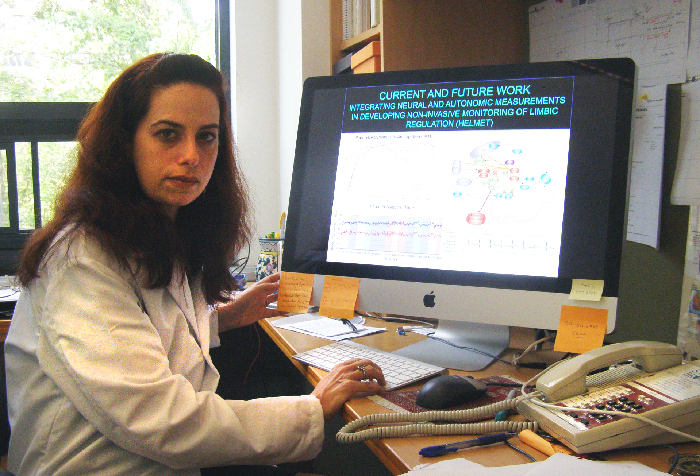 When it comes to understanding how the brain works, functional magnetic resonance imaging (fMRI) has pushed the field of neuroscience forward. But as a diagnostic tool, it still has a ways to go.
One big challenge of understanding fMRI results is sorting out which tiny signals are produced by brain activity and which are noise from the scanner. That was the problem that Stony Brook University neuroscientist Lilianne Mujica-Parodi and her lab were encountering in their work developing personalized computer models of individual brains. They wanted to understand how a person’s brain may react to medicine or decline with age, but their fMRI signals were drowning in scanner noise.
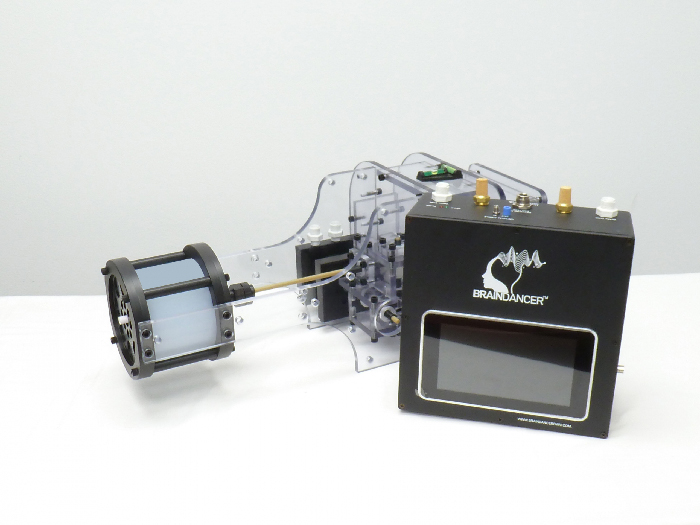
To remedy the problem, her team built a prototype device that could subtract out scanner noise better than previous technology had done. “We essentially created a biomechanical brain,” says Mujica-Parodi. When the researchers scanned the artificial brain, they could identify and remove the noise from the fMRI scanner.
Mujica-Parodi realized others in the fMRI research community could benefit from the technology. “Originally the plan was to reach out to one of the big scanner manufacturers, but that would have been the wrong strategy,” says Mujica-Parodi. “We needed a transition between a prototype and getting it out into the marketplace.”
To help with that transition, Mujica-Parodi applied for an NIH Research Evaluation and Commercialization Hub (REACH) grant through the Long Island Bioscience Hub (LIBH). The funding she received in 2016 helped her team develop their device, called BrainDancer, past the prototype phase. Beyond funding, the REACH program facilitated an introduction to ALA Scientific Instruments, a local small business interested in both manufacturing and commercializing the BrainDancer.
An infrastructure like REACH needs to exist in order to transition research prototypes to the commercial market.
Mujica-Parodi says REACH support helped her team better understand intellectual property and commercialization as well as help define their intended market. “I think that was part of what made these attempts so marketable right from the beginning.” Soon after, her team secured both Small Business Innovative Research (SBIR) and Small Business Technology Transfer (STTR) grants from the NIH. The BrainDancer will be available through ALA Scientific in May of 2021.
 Many researchers develop new solutions to solve their own problems, but bringing those innovations to market is tough, says Mujica-Parodi. “An infrastructure like REACH needs to exist in order to transition research prototypes to the commercial market. That sort of matchmaking—in terms of understanding who are the viable commercial partners and having enough expertise in both the science and also the business end of it to bring those two partners together—that is not something that I think would easily occur organically on its own.”